Why Songs Get Stuck in Your Head: What Earworm Research Can Tell Us
Explore involuntary musical imagery, the role of familiarity and melodic features, and why a catchy fragment is not a complete explanation of a listener’s mind.

A chorus returns while you are making tea, walking or trying to finish a quiet task. No music is playing, yet a short fragment seems ready for another repetition. Researchers call this involuntary musical imagery, often shortened to the everyday word “earworm.” The term describes a familiar experience; it does not mean there is one simple mechanism explaining every tune and every listener.
A remembered fragment rather than a complete performance
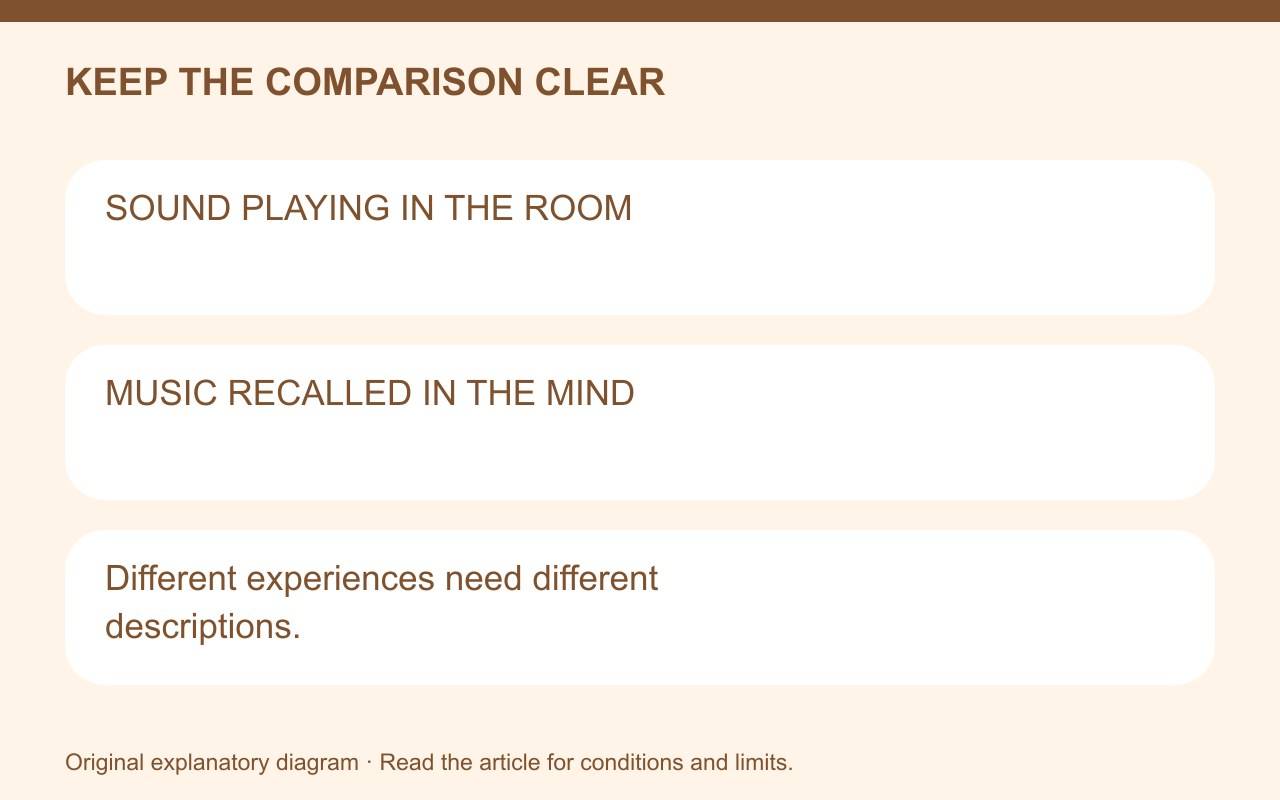
The musical image may be only a small part of a song. You might remember a hook without recalling the next verse, or a rhythm without being able to name the recording. That incompleteness matters when describing the experience. Remembering a few seconds of music is different from listening to the entire track through a speaker.
A recent narrative review catalogued in PubMed discusses the phenomenon as recurring musical fragments in the mind. Keep that description separate from a claim about an individual’s health. A general article about an ordinary catchy tune cannot assess persistent, distressing or unfamiliar experiences that need professional attention.
What a study can reveal about catchy tunes
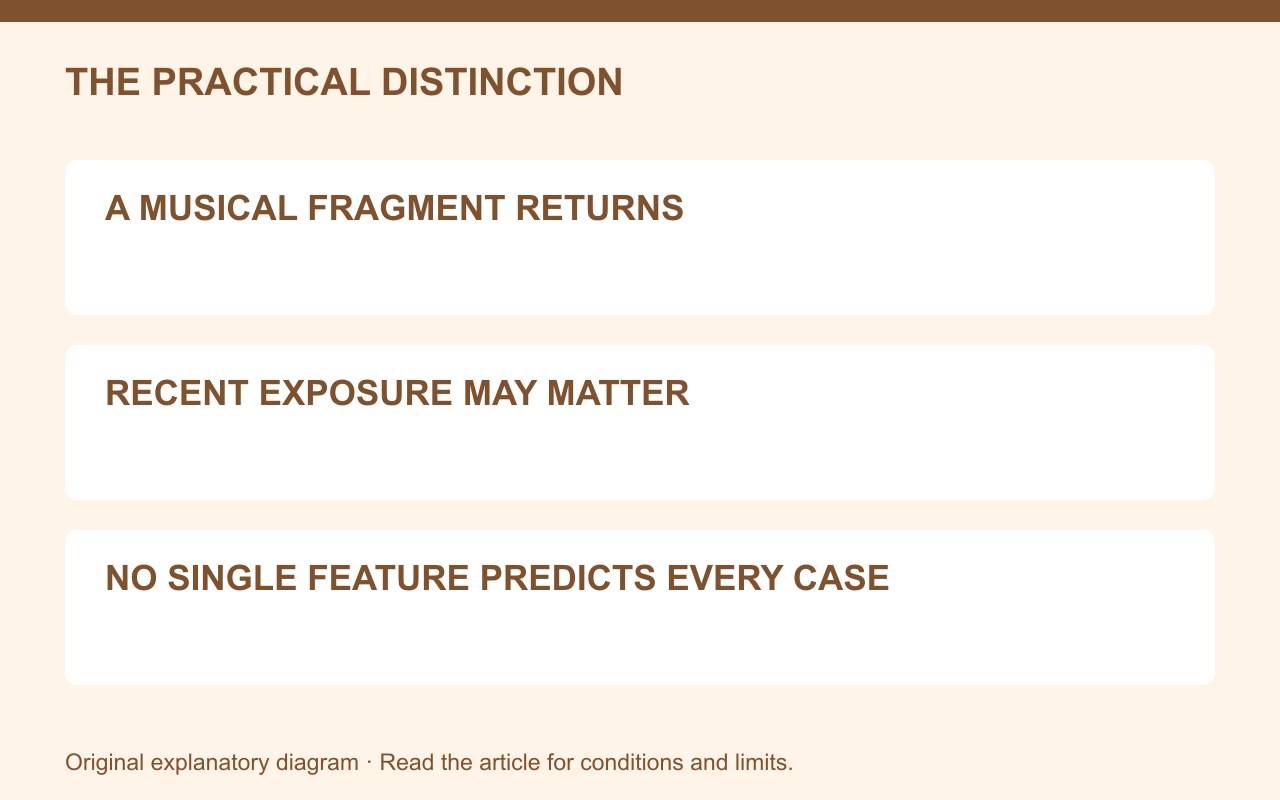
Kelly Jakubowski and colleagues investigated melodic features and song popularity in relation to reported involuntary musical imagery. Their research considered features of tunes as well as factors such as musical exposure. The study helps explain why a simple statement that “repetition causes everything” is incomplete: the material and the listener’s familiarity both deserve attention.
The APA summary describes tendencies among the reported earworms, including relatively fast tempo and a combination of familiar melodic shapes with distinctive intervals or repetitions. These are statistical findings from the study, not a formula guaranteeing that a songwriter can insert one feature and make a song loop in every listener’s mind.
Separate three useful questions
| Question | What it asks |
|---|---|
| What have I heard recently? | Whether recent exposure offers a plausible cue. |
| Which fragment is repeating? | What part of the music is actually being recalled. |
| What was happening when it appeared? | The context in which the memory became noticeable. |
Those questions are more informative than deciding that a song is objectively the catchiest ever because it returned to you this morning. A familiar chorus, an association with a place or a recent listening session may all be relevant. One episode cannot reveal the precise contribution of each factor.
Make a light observation, not an experiment on yourself
If you find the subject interesting, make a brief note after a naturally occurring episode. Record the fragment, whether you can identify it and any recent occasion when you remember hearing it. Add the activity you were doing. This is an original observation exercise, not a validated assessment or a requirement to monitor every thought.
For example, “chorus returned while washing dishes; heard the track yesterday” preserves a possible connection without claiming causation. “Unknown melody during a walk” is also a complete note. Avoid repeatedly replaying a track simply to make the diary more dramatic; that changes the exposure you are trying to describe.
Catchiness and musical quality are different judgements
A tune can be memorable without becoming your favourite, and a deeply valued performance may not produce a repeating fragment. Musical skill, emotional significance and the ease with which a phrase comes back are related questions rather than interchangeable measures of quality.
Our feature on Ella Fitzgerald’s scat singing offers a different listening task: noticing phrasing and musical choices in an actual performance. It is possible to enjoy those details without turning every memorable phrase into a contest for the most infectious hook.
Keep the limits of the explanation visible
Research identifies patterns across reports and musical material. It cannot tell you from one remembered chorus exactly what your brain is doing, or promise a universal technique for making every fragment disappear. If an experience is persistent, distressing or seems different from ordinary remembered music, discuss it with a qualified professional rather than relying on a catchy-song explanation.
For ordinary curiosity, the distinction is enough to make the phenomenon more interesting: there is a tune, a listener with a listening history and a context in which a fragment returns. Observing those layers gives a richer account than treating the song as a switch that works identically on everyone.